 Partial lifts do not produce Partial Results
Take a look around any gym for long enough and you will see quarter rep squats, half deadlifts and limited range pressing. Now it is easy to dismiss this as ego lifting and a one way ticket to snap city for these “bro lifters”
What if i was to tell you that these lifts when used correctly can actually improve your performance, strength and muscle building potential?
“Wait Sam, you’re a qualified PT and Strength Coach, how can you possibly give such damaging advice??”
Well dear reader I am here to say that Partials could be the missing link in your training and strength development.
Please don’t get this confused, I am not advocating loading as much weight on the bar and blowing your spine out on a squat you have no business in using, or tearing your shoulders out of their sockets with a deadlift that Eddie Hall wouldn’t even attempt.
I’m promoting the benefits that can be had from properly performed and programmed partial lifts.
In this article I will focus on the most bang for your buck ones you can utilise in your own training straight away and getting the benefits from them.
Most trainees only focus on the muscle being used when in the gym, they believe that by performing countless sets and reps, tearing the muscle down, going home recovering and coming back to rinse and repeat will give them the best muscle and strength gains. While this is correct they are forgetting about the very important connective tissues, tendons, ligaments and the bones themselves.
Loading the body with supramaximal loads ” Loads heavier than they could lift in a complete range of motion” over time will actually thicken your tendons, ligaments and even increase bone density which in part will enable you to produce more force, become a lot more injury resistant, reverse the aging process and light up your nervous system. This all means more weight on the bar and more muscle gain over the long term.
Rack Pulls
The most debated topic on internet forums and social media is people pulling partial deadlifts in the hopes it will increase their deadlift numbers. Now it is my belief as well as many others that to get good at something, you have to perform that thing. It’s the law of specificity.
No the rack pull will not instantly increase your deadlift max by 50kg (110 lbs for my friends across the pond)
The mechanics of it just don’t translate to a proper deadlift technique and pretty much has zero carryover to a conventional deadlift from the floor.
“So Sam, why the hell would I waste my time with something that doesn’t increase my gym lifts” I hear you say.
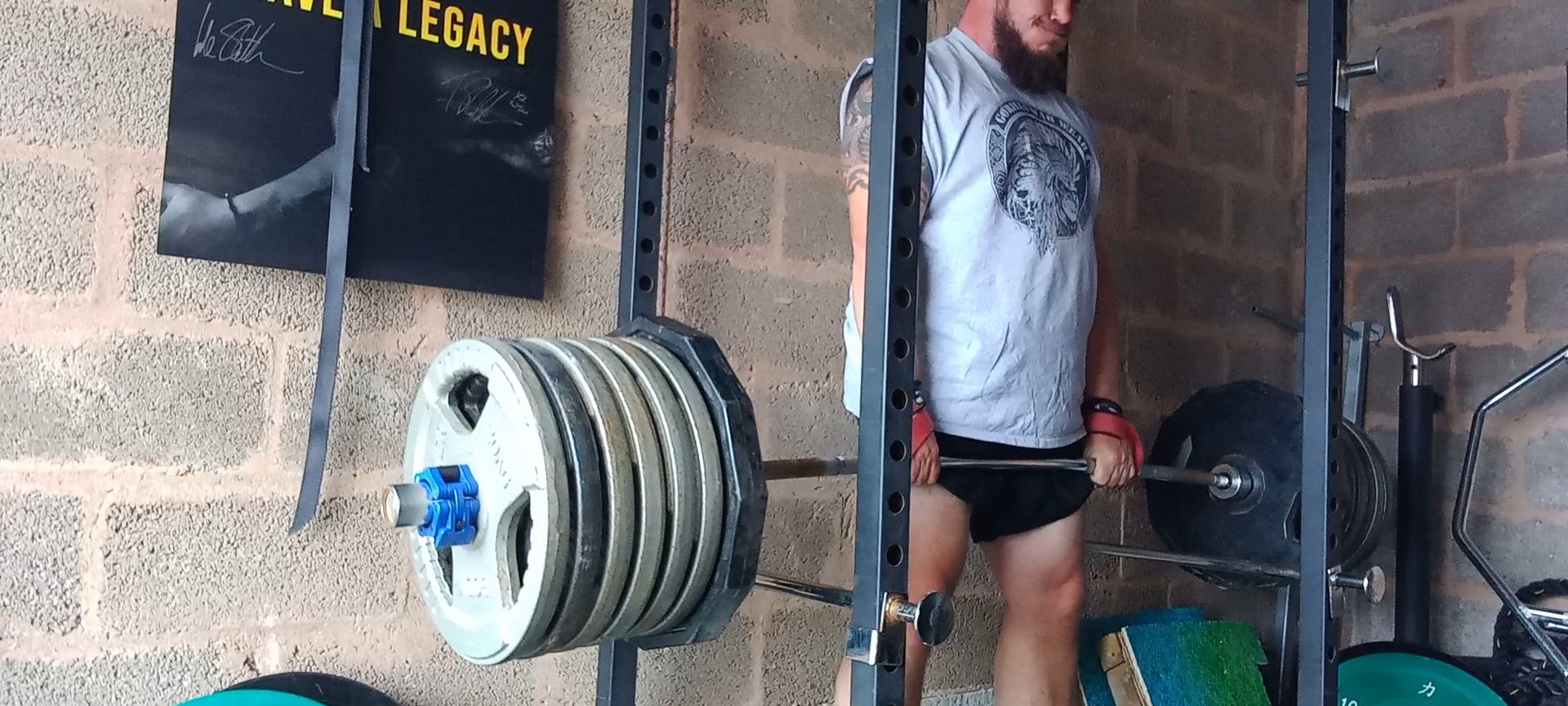
Here’s why, with the rack pull, especially when it’s performed above the knee, will enable us to overload all the tendons, ligaments and bone structure with heavy weight.
It gets the central nervous system firing on all cylinders and bullet proofs your joints.
It overloads your upper back and traps in a way no other gym lift could, which overtime will force adaptation and growth.
It also builds confidence with heavier weights, think about it if you have routinely been rack pulling 300kg plus, that 200kg deadlift from the floor will not feel so daunting.
It’s actually safer on the lower back as you will be starting in a much more upright position.
These benefits from one simple lift are just too important to ignore.
Now the downside to them…. They are known to be wreckers of barbells, so if you train in a gym with nice bars please don’t be the one that wrecks their beautiful eleiko power bars. Find an old one and use that as a dedicated “partials” bar, this advice will stand for any of these lifts in this article. Trust me your gym won’t thank you for bending a £1000 bar.
One way to negate the impact on the bar is by performing “block pulls” with the bar height set above your knees. This is the same as a rack deadlift but the weight plates are resting on a base instead of the bar resting on the safety bars of a power rack.
Squat Lockouts
Safety first. To perform these you need to have a power rack. There’s no other way you can perform these safely without one.
When performed properly the rack Squat will improve all over body strength and give you the core strength of a silverback gorilla.
We are not talking about the quarter squats you see on the internet where the individual takes there squat to way above parallel and hashtags it #SquatPRBros
This is a lift in and of itself which will be used to build a steel column where your spine should be, tendons like wire and the confidence of Connor Mcgregor.
Again like the rack pull, if you can Squat Lockout 250kg on your back, that next squat PR of 170kg will not feel anywhere near as heavy.
It also teaches total body tension, this will directly translate into any of your lifting. You just cannot physically unrack a weight 3-4 times your bodyweight without this tension.
Bench Lockouts
It was a toss up between talking about this or overhead rack lockouts. Both are great for overloading the triceps, shoulders and entire upper body but I feel that when combined with the deadlifts and squats the bench lockout is the better option as it will give your other joints, tendons, ligaments and bone structure a rest.
As with the Squats, you need a power rack to perform these safely as it would not be pleasant having a heavy bar come crashing down on you if you failed a lift.
The benefits of these are again the increased confidence under a heavy bar. Also you will be building all the tendons and ligaments in the elbows and wrists which will again bulletproof you against injury.
Now for the bit you’ve all been waiting for. “How the hell do I include these in my training and wont they negatively affect the rest of my workout?”
Now you have two options for programming these. You can either dedicate an entire session to them by performing the Squat, Bench and then finish with the rack pulls or you can tag them onto your existing split if you’re working something like a push, pull, legs, by doing them first in that session. example
1.Squat lockouts
2.Regular Squats
3.Single leg squat variation
4. Accessories such as leg extensions, leg curls ect
Sample four week programme
Week One:
Work up to a weight 30-40kg over your one rep max in the regular squat, bench and deadlift and perform 5 single reps with it
Week Two:
Same weight as week one but perform 8 singles with it
Week Three:
Add 20kg to your bench numbers and 30-40kg to your deadlift and squat numbers and perform 3 singles with this
Week Four:
Same weight as week three but perform 10 singles
And there you have it, I hope I have managed to dispel some myths on partial lifts and peaked your interest.
If you want to know more about the benefits of partials or any other “forgotten training methods” please reach out and email me on www.samhornpt@gmail.com
If you want to know more about how to train them into an effective programme I will be more than happy to write you a customised programme or train you one to one with any of the packages I have available on www.samhornpt.co.uk
Follow me on instagram: http://www.instagram.com/sam_horn_strength_systems
Stay strong
Sam
Sam Horn Strength Systems